
The AI Search Revolution: A New Era for Content

In today's fast-changing digital world, mastering ai content optimization strategies is no longer an option - it's a must.
For immediate impact, here's what AI content optimization strategies involve:
- Adapting to AI algorithms : Understanding how AI processes information.
- Structuring content : Making it clear, readable, and machine-friendly with Schema.
- Technical readiness : Ensuring fast load times and mobile optimization.
- Building authority : Gaining trust and citations from AI systems.
- Monitoring new metrics : Tracking success beyond traditional SEO.
For years, search engine optimization (SEO) was about keywords and backlinks. Your website would rank, and people would click through. But times have changed. AI is reshaping how users find information.
Now, AI search engines and agents act as new gatekeepers. They summarize answers, provide direct responses, and even make decisions for users. This means your content needs to be ready for them.
You might be seeing your usual traffic decline. Even with good rankings, your content isn't showing up in these new AI overviews or chatbot answers. It's frustrating.
This guide will show you how to adapt. We'll explore exactly what AI search wants and how to make your content shine. Get ready to put your content in front of this new wave of digital findy.
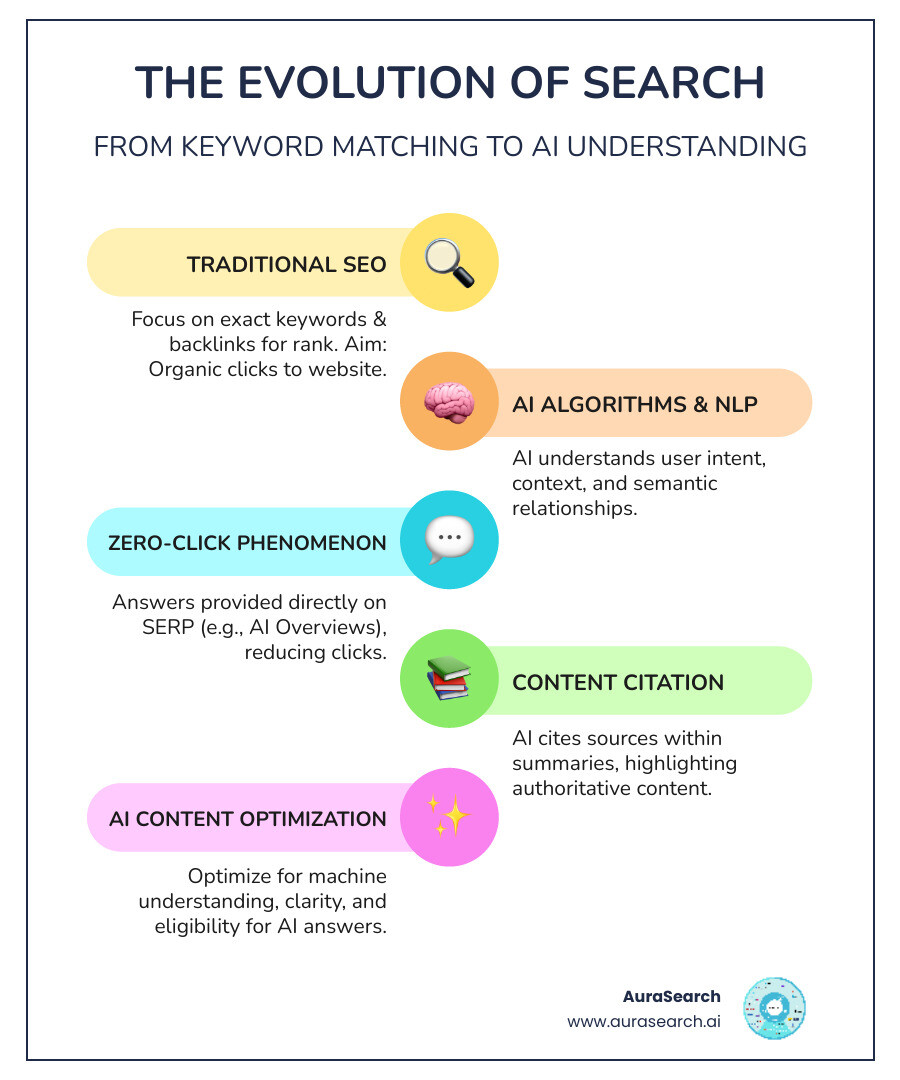
The fundamental differences between traditional SEO and AI search optimization are profound. Traditional SEO focused on matching keywords and building links to climb the "10 blue links" of search results. We aimed for organic clicks that took users directly to our websites. However, AI is fundamentally changing how search engines work. They don’t just look at what you type anymore—they actually try to figure out what you mean.
AI search algorithms process information differently. They leverage machine learning (ML) and Natural Language Processing (NLP) to understand user intent, context, and the relationships between entities far beyond simple keyword matching. This shift has led to a significant change in user behavior: 60% of Google searches in 2024 never left the search engine results page (SERP). This "zero-click" phenomenon is amplified by AI Overviews, which, as of June 2025, feature on a staggering 57% of Search Engine Results Pages (SERPs). This means AI provides answers directly on the SERP, often citing sources within the summary, reducing the need for users to click through to a website. Pew’s research makes it clear: if your content doesn’t appear in the summary, users probably won’t see it.
From Keywords to Concepts: How AI Processes Information
AI search algorithms don't just find keywords; they understand the concept behind your content. They prioritize content that aligns closely with the user's intent. This means moving beyond a single main keyword. We need to add related terms and phrases that give AI a richer context. This "semantic" approach makes it easier for AI engines to understand what our content is truly about. AI systems scan our writing, pull out key details, and decide whether it fully answers a user’s question. They process 30–50 million pages daily to find quality content for search, summarization, and question-answering.
This leads us to the evolving concepts of Answer Engine Optimization (AEO) and Generative Engine Optimization (GEO).
- Answer Engine Optimization (AEO) focuses on making content understandable, citable, and useful for AI models that generate answers, like in AI Overviews or chatbots. It's about providing direct, concise answers to user questions, anticipating their needs, and structuring information for easy extraction.
- Generative Engine Optimization (GEO) specifically addresses how AI systems process and distribute information in a generative context. While AEO is about being the source of the answer, GEO is the execution of that strategy, ensuring our content is semantically clear, contextually rich, and AI-readable so that large language models (LLMs) can confidently use and cite it.
Both AEO and GEO complement traditional SEO by building upon its core principles of quality and authority, but they adapt them for the unique ways AI systems consume and present information. We're no longer just optimizing for clicks; we're optimizing for understanding and citation.
The Rise of AI Crawlers and Agents
The way AI interacts with our websites is also different. Unlike traditional search engine crawlers like Googlebot, which are highly optimized, AI crawlers can be surprisingly inefficient. Studies show that AI crawlers are 47 times more inefficient compared to traditional crawlers. They also represent about 28% of Googlebot’s volume in recent traffic analysis, indicating their growing presence. A significant challenge is their limited JavaScript rendering capabilities; only Google’s Gemini and AppleBot currently render JavaScript among major AI crawlers. This means if our content relies heavily on client-side JavaScript to display, many AI crawlers might not see it, leading to 34% of AI crawler requests resulting in 404 or other errors.
Beyond just crawling for information, a new frontier is emerging: AI agents that can actively make decisions on behalf of users. In 2025 and beyond, these AI agents won’t just passively suggest information—they’ll actively complete tasks. For our content to be visible and usable by these powerful agents, we need to implement "agent-responsive design." This means structuring our site so AI can easily interpret and interact with it, ensuring interactive elements are clearly defined and accessible, and minimizing unnecessary interactions like pop-ups.
Here are some key user-agents for major AI crawlers that website owners should be aware of:
- OpenAI: GPTBot, ChatGPT-User, OAI-SearchBot
- Google: Google-Extended, GoogleOther
- Anthropic: ClaudeBot
- Andi: AndiBot
- Perplexity: PerplexityBot
- You.com: YouBot
- Phind: PhindBot
- Exa: ExaBot
- Firecrawl: FirecrawlAgent
- Common Crawl: CCBot
Understanding these user-agents and their behavior is crucial for effective ai content optimization strategies . We need to ensure our content is accessible to the right bots. To learn more about AI crawlers and their behaviors, we recommend to Learn more about AI crawlers.
Foundational AI Content Optimization Strategies: Structure & Clarity
The foundation of successful ai content optimization strategies starts with one simple truth: quality matters more than ever. AI systems don't just scan for keywords—they evaluate whether your content genuinely helps people. This means we need to focus on what search engines and AI platforms value most: clear, trustworthy, and well-structured information.
At the heart of this approach is E-E-A-T (Experience, Expertise, Authoritativeness, and Trustworthiness). Think of E-E-A-T as your content's credentials. When AI systems decide whether to cite your content in their responses, they're looking for these trust signals. Strong E-E-A-T tells both search engines and AI platforms that your content deserves to be featured prominently.
Here's what makes this even more important: AI models prioritize content that's clear and easy to read . Peer-reviewed studies show that clarity wins when it comes to AI citations. Content with specific data points is 30-40% more likely to appear in AI-generated responses, while an authoritative tone makes your content up to 30% more likely to be featured in AI overviews.
This isn't just about writing for machines, though. When you create content that AI can easily understand and extract information from, you're also creating content that humans find more valuable and engaging.

Crafting Your Content: Applying AI Content Optimization Strategies for Readability
When it comes to making your content AI-friendly, simplicity is your secret weapon . AI models process information much like speed readers—they want to quickly identify key points and extract meaningful information. The easier you make this process, the more likely your content will be featured in AI responses.
Simple language works best . Skip the jargon and complex vocabulary that might impress your college professor but confuses AI systems. Write as if you're explaining something to a friend over coffee. This conversational tone not only helps AI understand your content but also makes it more engaging for human readers.
Keep your sentences short and punchy . Aim for 15-20 words per sentence. Long, winding sentences with multiple clauses make it harder for AI to parse your main points. Think of each sentence as delivering one clear idea.
Break up your content into bite-sized paragraphs . Two to three sentences per paragraph is ideal. This creates natural stopping points that help both AI and human readers process information more easily. White space isn't wasted space—it's breathing room for your ideas.
Lead with your answers . When someone asks a question, don't make them wait three paragraphs for the answer. AI models prefer content that provides 2-3 sentence core answers right upfront, followed by supporting details. This structure makes your content perfect for AI citations.
To make your content truly citation-ready for AI systems, structure your paragraphs around 60-100 words each . Start with your main point, add supporting details, then reinforce the key takeaway. This format gives AI systems exactly what they need to confidently reference your content.
Use formatting to guide attention . Bold text, bullet points, and numbered lists aren't just pretty—they're signposts that help AI identify your most important information. Tools like Grammarly can help you refine your content for maximum clarity and readability.
Here's how the difference looks in practice:
| Poorly Structured Content for AI | Well-Structured Content for AI |
|---|---|
| Long, complex paragraphs that bury key information deep within dense text blocks, making it difficult for AI systems to extract clear, actionable insights while also overwhelming human readers with too much information at once. | Clear, direct answers lead each section. Key points are bolded for emphasis . Short paragraphs focus on one idea. Specific data supports claims. |
| Jargon-heavy language with multiple subordinate clauses and complex sentence structures that require significant processing power to understand. | Simple language explains concepts clearly. Short sentences deliver one idea each. Active voice keeps things moving. |
| No clear structure or hierarchy, with important information scattered throughout without logical organization or formatting cues. | Descriptive headings organize content. Bullet points highlight key features. Data is presented in easy-to-scan formats. |
Structuring for Success with Schema and Data
While great writing forms the foundation of ai content optimization strategies , structured data acts as a bridge between your content and AI systems. Think of structured data as a translator that helps AI understand exactly what your content is about and how it should be categorized.
Schema markup is your content's ID card . When you add schema markup from Schema.org , you're essentially giving AI systems a detailed description of what each piece of your content represents. Is it a how-to guide? A product review? A frequently asked question? Schema tells AI exactly what they're looking at.
The most valuable schema types for AI optimization include FAQ schema , which helps your Q&A content appear in AI responses, HowTo schema for step-by-step guides, and Product schema for e-commerce content. Each of these markup types makes it easier for AI to understand and cite your content appropriately.
JSON-LD is the preferred format for implementing schema markup. It's clean, easy to implement, and doesn't clutter your visible content. More importantly, it's the format that most AI systems can read and understand most effectively.
The payoff for properly structured data goes beyond just AI visibility. Rich snippets in traditional search results, improved listings, and better categorization all flow from good schema implementation. When your content is properly marked up, it becomes more findable across all platforms—both traditional search engines and AI systems.
Using AI to Boost Your Optimization Workflow
Here's where things get interesting: you can use AI to optimize for AI . Smart content creators are already leveraging AI tools to identify gaps in their content, generate compelling headlines, and analyze readability—all while maintaining the human touch that makes content truly valuable.
Content gap analysis becomes much more powerful when AI helps identify what questions your audience is asking that you haven't answered yet. AI tools can scan competitor content, social media conversations, and search queries to reveal opportunities you might have missed.
Headline generation is another area where AI excels. While you should always review and refine AI-generated headlines, they can provide fresh perspectives and help you test different approaches to the same topic. The key is using AI as a starting point, not an endpoint.
For technical analysis, AI-powered tools can evaluate your content's readability, suggest improvements for sentence structure, and even predict how well your content might perform in AI-generated responses. Many modern SEO platforms now include AI-focused features alongside their traditional capabilities.
The important caveat : don't become over-reliant on AI tools. They're powerful assistants, not replacements for human judgment and creativity. The most successful ai content optimization strategies combine AI efficiency with human insight, ensuring your content remains authentic and valuable to real people while being perfectly optimized for AI systems.