
The AI Revolution: Why Optimize Your Content Now?

To how to optimize ai content for seo , focus on these core strategies:
- Understand AI Algorithms & User Intent : AI prioritizes content that deeply understands and addresses user queries, moving beyond simple keywords.
- Create Human-Friendly Content : Write clear, comprehensive, and valuable content that resonates with human readers first.
- Leverage Structured Data : Use schema markup to help AI understand your content's meaning and categorize it effectively.
- Optimize Technical SEO : Ensure your website is fast, mobile-friendly, and easily crawlable by AI bots.
- Build Authority (E-E-A-T) : Establish your expertise, authoritativeness, and trustworthiness to gain AI recognition and citations.
How people find information is changing. Search engines now use advanced Artificial Intelligence (AI), moving beyond simple keyword matching. This shift significantly impacts content visibility.
As of June 2025, a staggering 57% of Search Engine Results Pages (SERPs) feature AI Overviews. These AI-generated summaries provide direct answers, reducing the need for users to click through to websites. Platforms like ChatGPT, Gemini, and Perplexity are also reshaping information findy, often citing sources in their responses.
For content creators, this is a fundamental change. Traditional SEO tactics, while still important, are no longer enough. You must adapt your strategy with what we at AuraSearch call Generative Engine Optimization (GEO). This new approach ensures your content is not only seen but also understood, summarized, and cited by AI.
Ignoring this shift means risking your content becoming invisible.
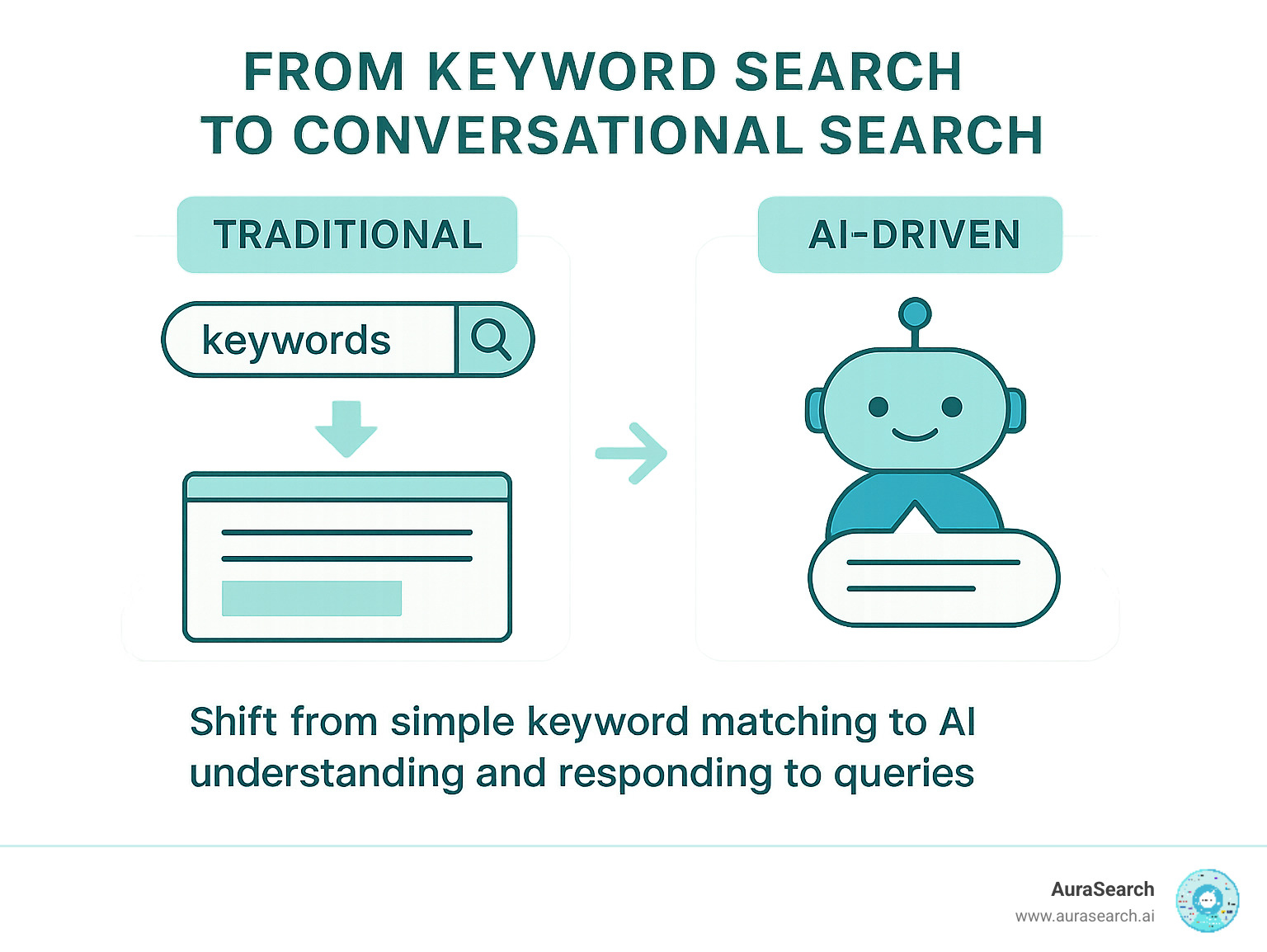
Understanding the New AI Search Landscape
The search landscape is undergoing a deep shift. Understanding it is the first step to learning how to optimize ai content for seo . AI helps search engines understand user intent, not just keywords, to provide direct answers. This move from keyword matching to understanding user needs is powered by Natural Language Processing (NLP) and machine learning.
Traditional SEO focused on keywords, links, and technical health. AI SEO, or Artificial Intelligence Optimization (AIO), adds a new layer: creating clear, structured content that AI can easily understand and use. The goal is to become a primary source for AI-generated answers.
AI assistants like ChatGPT, Google's AI Overviews, and Perplexity are becoming primary search tools. ChatGPT and Perplexity often use Bing, while Gemini uses Google Search. Perplexity consistently cites sources for factual queries, offering a clear path for content visibility, unlike other models that may require a prompt for sources.
How AI Search Algorithms See Your Content
Modern AI search algorithms use advanced NLP for semantic search, understanding the context, meaning, and user intent behind queries, not just keywords. These algorithms favor content that matches user intent with detailed explanations and demonstrates quality and trustworthiness through E-E-A-T (Experience, Expertise, Authoritativeness, and Trustworthiness).
AI has increased "zero-click searches," where users get answers directly on the SERP. In 2024, 60% of Google searches were zero-click. Your content must be structured for easy extraction by AI for these answer boxes.
Want to dive deeper into how we approach AI SEO? Head over to our AuraSearch AI Blog. You'll find lots more info there!
Why Optimizing for AI is Non-Negotiable
Optimizing for AI is essential for staying relevant. Here’s why you can’t afford to wait:
- AI Overviews are Everywhere : As of June 2025, 57% of SERPs feature AI Overviews. Their summaries, with about 8 links, offer a great chance to be seen.
- The Rise of Voice Search : The growth of voice search requires content optimized for natural, conversational questions, which AI models handle well.
- Future-Proofing Your Strategy : AI agents will make decisions for users starting in 2025. Content not optimized for Large Language Models (LLMs) risks being missed.
- Increased User Engagement : Optimizing for AI boosts engagement. One study showed a 67% traffic increase from Perplexity and doubled newsletter sign-ups. AI tools can drive 10% of traffic to some sites.
- Competitive Advantage : Early adoption of AI SEO strategies provides a significant advantage over competitors who fail to adapt.
Core Strategies for AI Content Optimization
At the heart of how to optimize ai content for seo is a simple truth: what’s good for humans is good for AI. Clear, relevant, and helpful content appeals to both. The goal is to create high-quality content that meets user needs.
Beyond good writing, building authority is key. AI prioritizes E-E-A-T (Experience, Expertise, Authoritativeness, and Trustworthiness). Establish credibility by publishing expert content, displaying author credentials, and earning backlinks and media mentions.
How to Optimize AI Content for SEO with AI-Friendly Writing
AI-friendly writing adds a strategic layer to human-friendly writing, making content easy for both people and machines to understand.
First, understand user intent . Ask why someone is searching. Use tools like Google's Keyword Planner or Ahrefs to identify core needs and optimize your content to answer them directly.
Next, use conversational queries . With the rise of voice search, incorporate longer, question-based keywords. Tools like AnswerThePublic can help find these queries.
Prioritize clarity, simplicity, and readability . AI, like humans, prefers easy-to-read content. Use short paragraphs, bullet points, and lists. Avoid jargon and complex sentences; simple language is more effective.
Provide depth and detail . AI favors comprehensive content that explores topics thoroughly, making it more likely to be cited.
For YMYL topics (health, finance), AI emphasizes accuracy and authority . For these queries, 91% of cited articles used lists, with an average word count of 1,000. General queries averaged 1,500 words, but length can vary widely.
AI prefers lists (used in 91% of cited YMYL articles), how-to guides (great for step-by-step solutions), and FAQ sections (provide ready-made answers). Regularly updating content also signals relevance to AI.
Structuring Content for Easy AI Extraction and Citation
To be cited by AI, your content structure is critical. It must be machine-readable without sacrificing human readability.
Structured Data (Schema Markup) is crucial. Using Schema.org helps AI understand and categorize your content. Implementing schema for FAQs, How-Tos, and Articles increases your chances of appearing in rich results and AI summaries.
Optimize for Featured Snippets . Snippet-worthy content often appears in AI Overviews and can boost CTR by 42%. To earn them, provide concise answers, use lists and tables, and have clear headings.
Text Fragments
( #:~:text=
) direct AI to specific content, improving your chances of being featured. Using long-tail keywords in text fragments can improve snippet appearances by up to 55.5%.
Clear Headings (H1, H2, H3) are foundational. They create a logical flow and help AI understand your content's hierarchy and main points, simplifying information extraction.
Bullet Points and Numbered Lists are excellent for AI extraction. They present information in a digestible format that AI can easily use in summaries and direct answers.
Build Comprehensive FAQ Sections . Addressing common and follow-up questions serves user intent and provides AI with ready-made Q&A pairs for direct answers.
How to Optimize AI Content for SEO on Major Platforms
While core principles are consistent, understanding the nuances of different AI platforms is vital for how to optimize ai content for seo . Each platform has unique behaviors, and tailoring your content to them can boost visibility.

Not all AI models cite sources equally. Perplexity provides source links 100% of the time for informational queries, offering a clear path to referral traffic. In contrast, ChatGPT rarely provides links unless prompted, and Gemini does so only about 30% of the time, requiring a targeted strategy.
Optimizing for Citation-Heavy AI Models
For citation-heavy platforms like Perplexity, fine-tune your content as follows to earn valuable links:
First, anticipate follow-up questions . Perplexity often generates them. Research these questions (using Perplexity itself or tools like AnswerThePublic) and address them in your content to increase your chances of being cited for related searches.
Next, cite reputable sources in your content. Linking to authoritative domains like .gov , .edu , and trusted .com sites signals credibility to AI and reinforces your E-E-A-T.
Perplexity AI seems to prefer diagrams, charts, and graphs . These visuals make data accessible and are common in credible sources. Use unique, high-quality data visualizations to attract AI's attention.
Leverage video content . Videos are increasingly cited, especially for non-YMYL queries on platforms like Perplexity. Using YouTube can increase your chances of being referenced. For general queries, images were referenced about 70% of the time, showing the importance of rich media.
Finally, consider affiliate content optimization . Platforms like Perplexity cite articles with affiliate links, presenting a new opportunity, especially given Google's stricter stance.
Getting Cited by AI Overviews and Other AI Search Engines
To get cited in AI Overviews and other AI search results, focus on these key areas:
Focus on Domain Authority and E-E-A-T . AI emphasizes domain authority, especially for YMYL topics. Build authority through expert publishing, quality backlinks, and social proof. AI evaluates these signals to determine credibility.
Maintain content freshness . AI favors frequently updated content. Regularly update articles to reflect current information, which signals relevance and increases citation chances. Ensure visible dates and meta tags show your content is current.
In-depth guides and how-to content are ideal formats. They provide the comprehensive, detailed information that AI algorithms prioritize when seeking valuable content.
Showcase author credentials . Credible author bios are a significant factor for AI. Clear bylines and bios highlighting expertise demonstrate the "Expertise" and "Trustworthiness" aspects of E-E-A-T.
For more detailed strategies on optimizing specifically for AI Overviews, be sure to check out our AI Overviews best practices on the AuraSearch blog. We're always sharing the latest insights to help you win in the AI search landscape!
Advanced Tactics and Tools for Your AI SEO Playbook
To master how to optimize ai content for seo , you must go beyond content writing. This means embracing technical SEO and powerful AI tools to upgrade your toolkit for the AI era.

AI-powered tools are now essential. They automate SEO tasks, analyze data quickly, and identify optimization opportunities. To stay ahead, regularly audit your content and stay current with developments in AI, SEO, and Generative Engine Optimization (GEO).
Leveraging the Best Tools for Content Optimization
The market has many AI tools. Here are key categories to boost your content strategy.
Content Generation Tools like ChatGPT or Jasper AI can help draft content and spark ideas. However, human oversight is crucial to review, refine, and ensure accuracy, originality, and brand voice.
SEO Analysis Tools like Ahrefs, SERanking, and Clearscope provide AI-driven insights to guide your content strategy. Tools like Frase and MarketMuse are excellent for keyword research, content planning, and building topic clusters.
For Content Planning & Testing , MarketMuse helps you strategize by identifying important topics. Market Brew allows you to create a test search engine to refine your SEO efforts.
Voice Search Optimization Tools like AnswerThePublic help you find common conversational queries, so you can tailor your content to answer them directly.
How to Optimize AI Content for SEO by Mastering Technical Factors
Technical SEO is the bedrock of visibility for traditional search and AI crawlers. AI favors content that is easily accessible and provides a smooth user experience.
Mobile Optimization is non-negotiable. With over half of web traffic from mobile, AI algorithms favor mobile-friendly, responsive websites.
Page Speed is critical. AI systems may only wait 1-5 seconds to retrieve content. Slow load times can cause AI to move on or truncate your content. Optimize images, use browser caching, and consider a CDN. A website audit tool like SERanking can identify speed issues.
HTTPS is a fundamental trust signal for both traditional search and AI algorithms, indicating your site is secure.
Use Clean HTML and Structure
. AI crawlers process clean HTML or markdown more easily than JavaScript. Use proper semantic markup ( <article>
, <section>
), clear headings, and minimize client-side JavaScript for essential content.
Consider creating an llms.txt
file
. Similar to robots.txt
, this file gives LLM crawlers specific instructions on how to access and use your content for training or search queries.
Manage Crawler Accessibility
. Your robots.txt
and firewall rules need a nuanced approach. Welcome helpful AI search crawlers while setting boundaries for data collection bots.
Measuring Success and Proving ROI in the AI Era
In the AI era, measuring success means looking beyond clicks to metrics like citations, direct answers, and becoming a trusted source for AI. This demonstrates the ROI of your efforts in how to optimize ai content for seo .
Ranking first isn't a temporary win; it's about long-term dominance. Benford's Law, a mathematical principle, suggests that the first position gets disproportionate attention. Content ranking first is more likely to be cited by AI, creating a positive feedback loop that reinforces its authority.
Key Metrics to Track for AI SEO
To measure the impact of how to optimize ai content for seo , track these key metrics beyond traditional SEO numbers.
Track AI-driven traffic from sources like Google's AI Overviews and Perplexity. Use custom segments in Google Analytics to monitor this. AI tools already drive about 10% of traffic to some sites, with Perplexity being a valuable source.
Citation tracking is crucial. Monitor how often AI models reference your content. New tools like Peec.ai can help track AI citations and brand mentions, showing how AI uses your content.
Monitor snippet performance . Track how often your content appears in featured snippets using tools like Google Search Console or SpyFu. Content in featured snippets is likely to appear in AI Overviews.
Focus on user engagement for AI-driven traffic. Metrics like bounce rate and time on page signal to AI that your content is valuable and satisfies user intent.
Track voice search metrics . Use Google Search Console to see traffic from voice-enabled devices and measure the performance of your voice search optimization.
The Importance of Ranking First: Benford's Law in AI Search
Benford's Law, a mathematical principle, has significant implications for AI SEO. It suggests the number "1" appears as the leading digit about 30.1% of the time in many datasets. In search rankings, this means the first position gets a disproportionate amount of attention and references.
This matters for how to optimize ai content for seo because AI models favor high-ranking, authoritative content for generating answers. Consistently ranking first creates a positive feedback loop: more citations lead to greater perceived authority, which leads to more citations. This first-mover advantage helps you become a definitive source for AI, securing your long-term visibility.
Frequently Asked Questions about Optimizing AI Content
It's natural to have questions about the impact of AI on search. Here are answers to common questions about how to optimize ai content for seo .
What is the main difference between AI SEO and traditional SEO?
Traditional SEO focused on keywords and crawlability to rank 'blue links' in search results. AI SEO is different. AI-powered search engines focus on understanding user intent to provide direct answers on the results page, often eliminating the need for a click.
While traditional SEO was about being seen , AI SEO is about being understood and used by algorithms. This requires content structured for both humans and machines that demonstrates strong E-E-A-T (Experience, Expertise, Authoritativeness, and Trustworthiness), a shift from keyword matching to contextual understanding.
Can I use AI-generated content and still rank in search results?
Yes, you can use AI-generated content and still rank. Google's stance is that the quality and relevance of the content matter most, not how it was created.
Use AI as a powerful assistant for research, brainstorming, and drafting . However, human oversight is essential to refine, fact-check, add unique insights, and inject your brand's personality and experience.
The key is to use AI to improve your process, not replace it. Unedited, low-quality AI output will not perform well. Combining AI's efficiency with human expertise creates valuable, original content that can succeed in search.
How do I get my content cited in AI Overviews?
Getting cited in AI Overviews is a top goal for how to optimize ai content for seo . Here’s how to boost your chances:
First, demonstrate E-E-A-T . Prove your credibility to AI with clear author bios, high-quality content, and validation through backlinks and mentions. AI cites sources it trusts.
Next, provide clear, direct answers upfront. Use the 'inverted pyramid' style, putting the most important information first, so AI can easily extract the main point.
Use structured data . Implementing schema markup (e.g., FAQ, HowTo) helps AI understand and categorize your page's key information, making it easier to extract for summaries.
It's also crucial to build topical authority . Go deep on subjects by creating comprehensive content. This signals to AI that you are an authoritative source.
Finally, keep your content fresh . Regularly update your articles to ensure accuracy and timeliness, as AI favors current, relevant information.
Conclusion
The digital landscape is being reshaped by AI. The question of how to optimize ai content for seo is now fundamental to online visibility, ensuring your content reaches its intended audience.
Search has evolved beyond keywords to understanding user intent, context, and information trustworthiness. Adapting your strategy is a necessity to avoid being left behind.
Our AI SEO playbook combines several key strategies. It starts with understanding AI algorithms and user intent and involves crafting human-friendly, machine-readable content so your insights can be easily extracted by AI.
We also covered leveraging structured data , mastering technical SEO , and building E-E-A-T —the cornerstone of earning AI's trust. This includes optimizing for citation-heavy models like Perplexity , getting cited in AI Overviews , and measuring success with AI-centric metrics to prove ROI.
The future of search is intelligent and conversational. By focusing on quality, authority, and smart optimization, your content can become a go-to source for AI citations, driving meaningful engagement.
At AuraSearch, we are excited to guide businesses on this journey. As the only platform offering expert generative AI SEO services, we are uniquely positioned to help you win in the AI-driven search world.
Don't let your amazing content get lost in the shuffle. It's time to shine! Get started with expert AI SEO services today, and let’s confidently step into this incredible AI era together.